ImagineFX / August 2006
Artist Insight Series: Intro to Life Drawing
Setting Up Your Model
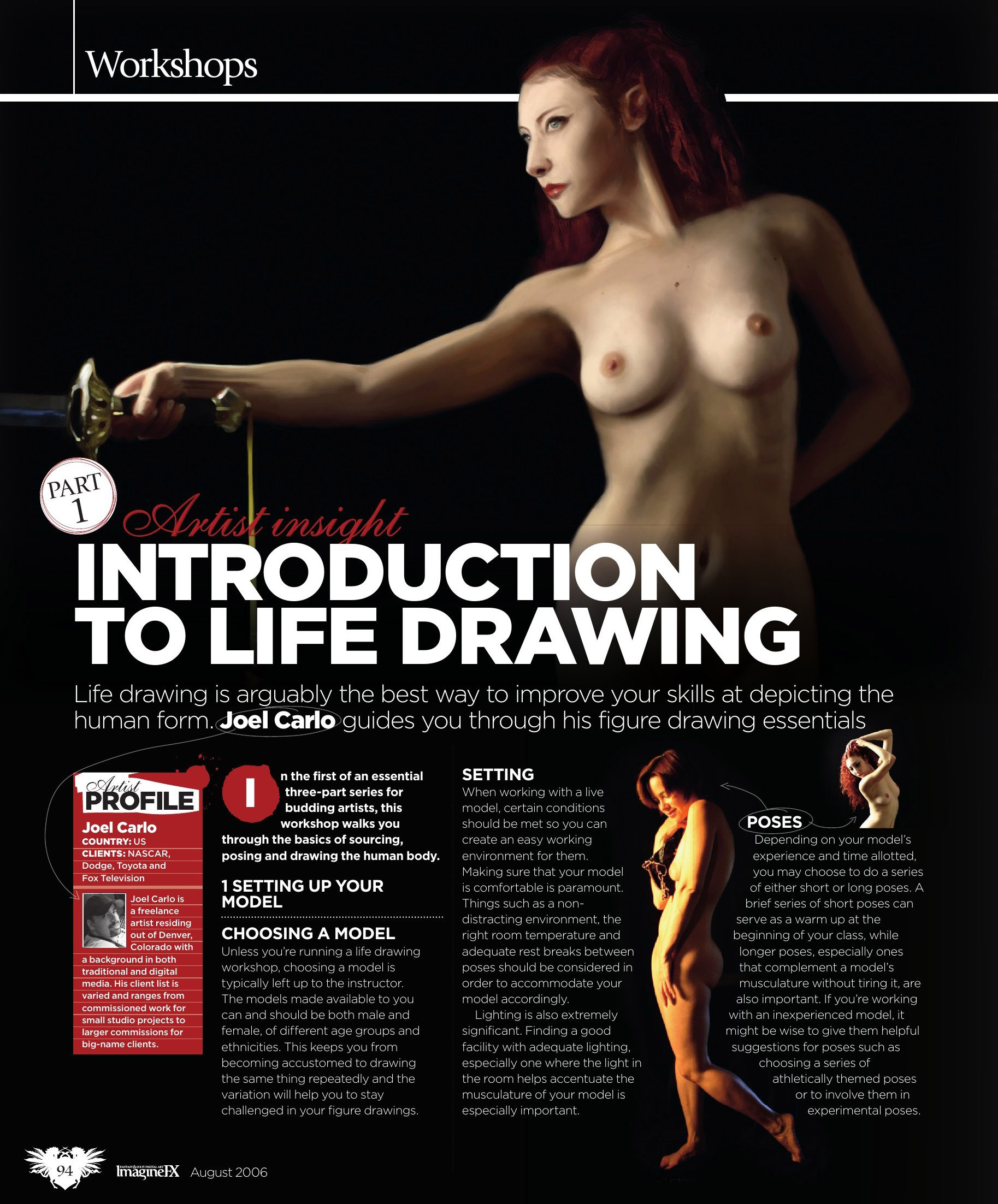
Choosing a model - Unless you are running a life drawing workshop, choosing a model is typically left up to the instructor. The models made available to you can and should be both male and female, of different age groups and ethnicities. This keeps you from becoming accustomed to drawing the same thing repeatedly and the variation allows for an increased challenge in your figure drawings.
Setting - When working with a live model, certain conditions should be met in order to create a comfortable environment that allows for good work. Making sure that your model is comfortable is very important. Things such as a non-distracting environment, room temperature and adequate rest breaks between poses are things that should be considered in order to accommodate your model accordingly. Lighting is also extremely significant. Finding a good facility with adequate lighting, especially one where the light in the room helps accentuate the musculature of your model is especially important.
Poses - Depending on your model's experience and time allotted, you may choose to do a series of either short or long poses. A brief series of short poses can serve as a warm up at the beginning of your class, while longer poses, especially ones that compliment a model's musculature without tiring it, are also important. If working with an inexperienced model, you may give them helpful suggestions for poses such as choosing a series of athletically themed poses or to experiment by exercising their own discretion.
Model Alternatives
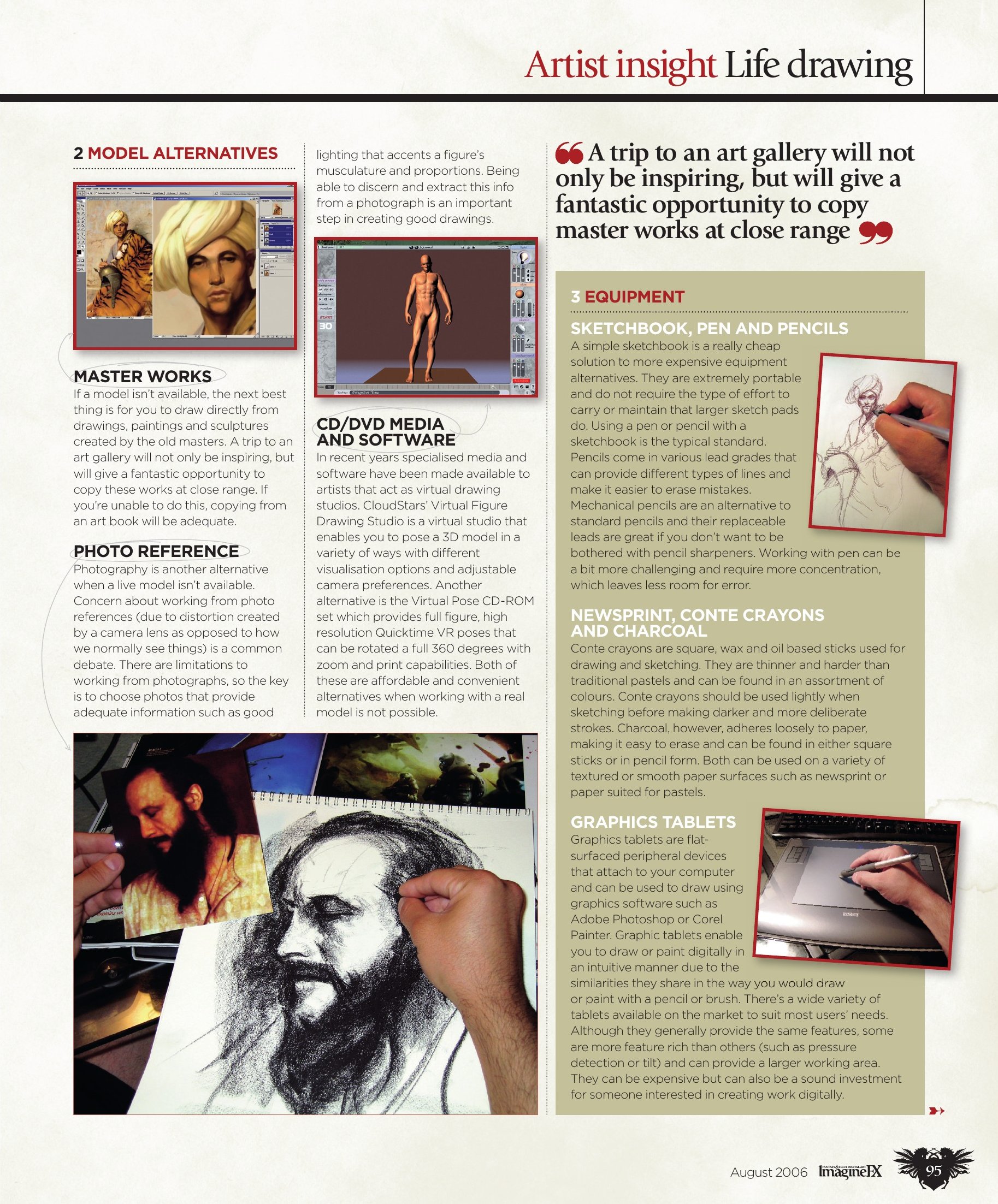
Master Works - If a model can not be made available to you, the next best thing would be to draw directly from Master Works. This would include drawings, paintings and sculpture created by the old masters. Alternatively, if you are not able to work directly from master works, copies of them are also a suitable solution.
Photo Reference - Photography is another alternative when a live model is not available. Concern about working from photo reference (due to distortion created by a camera lens as opposed to how we normally see things) is a common debate. There are limitations to working from photography, so the key is to choose photos that provide adequate information such as good lighting that accents a figure's musculature and proportions. Being able to discern and extract this information from a photo is an important step in creating good drawings.
CD/DVD Media & Software - In recent years specialized media and software have been made available to artists that act as virtual drawing studios. Cloudstars Virtual Figure Drawing Studio is a virtual studio that allows you to pose a 3D model in a variety of poses with different visualization options and adjustable camera preferences. Another alternative is the Virtual Pose CD-Rom set which provides full figure, high resolution Quicktime VR poses that can be rotated a full 360 degrees with zoom and print capabilities. Both of these are affordable and convenient alternatives when working with a real model is not possible.
Equipment
Sketchbook, Pen & Pencils - A simple sketchbook is a very affordable solution to more expensive equipment alternatives. They are extremely portable and do not require the type of effort to carry or maintain that larger sketch pads do. Using a pen or pencil with a sketchbook is the typical standard. Pencils come in various lead grades that can provide different types of lines and make it easier to erase mistakes. Mechanical pencils are an alternative to standard pencils and their replaceable leads are great if you do not want to be bothered with pencil sharpeners. Working with pen can be a bit more challenging and require more concentration which leaves less room for error.
Newsprint, Conte Crayons & Charcoal - Conte crayons are square, wax and oil based sticks used for drawing and sketching. They are thinner and harder than traditional pastels and can be found in assortment of colors. Conte' crayons should be used lightly when sketching before making darker and more deliberate strokes. Charcoal, however, adheres loosely to paper, making it easy to erase and can be found in either square sticks or in pencil form. Both can be used on a variety of textured or smooth paper surfaces such as newsprint or paper suited for pastels.
Graphic Tablets - Graphic tablets are flat-surfaced peripheral devices that attach to your computer and can be used to draw using graphics software such as Adobe Photoshop or Corel Painter. Graphic tablets allow you to draw or paint digitally in an intuitive manner due to the similarities they share in the way you would draw or paint with a pencil or brush. There is currently a wide variety of tablets available on the market to suit most users' needs. Although they generally provide the same features, some are more feature rich than others (such as pressure detection or tilt) and can provide a larger working area. They can be expensive but can also be a sound investment for someone interested in creating work digitally.
Basics of Drawing Human Form
Shape - Understanding shape and form is one of the quickest ways of achieving good control and depth in figure drawing. Training yourself to think in three dimensions helps give your drawings weight and thickness. Most objects can be reduced to simple geometric shapes. A torso can be seen as group of cubes or boxes. Arms and legs can be seen as cylindrical in shape while the human head can be reduced to a simple sphere. Visualizing the figure as a combination of basic shapes enables you to draw form that contains bulk, weight and depth.
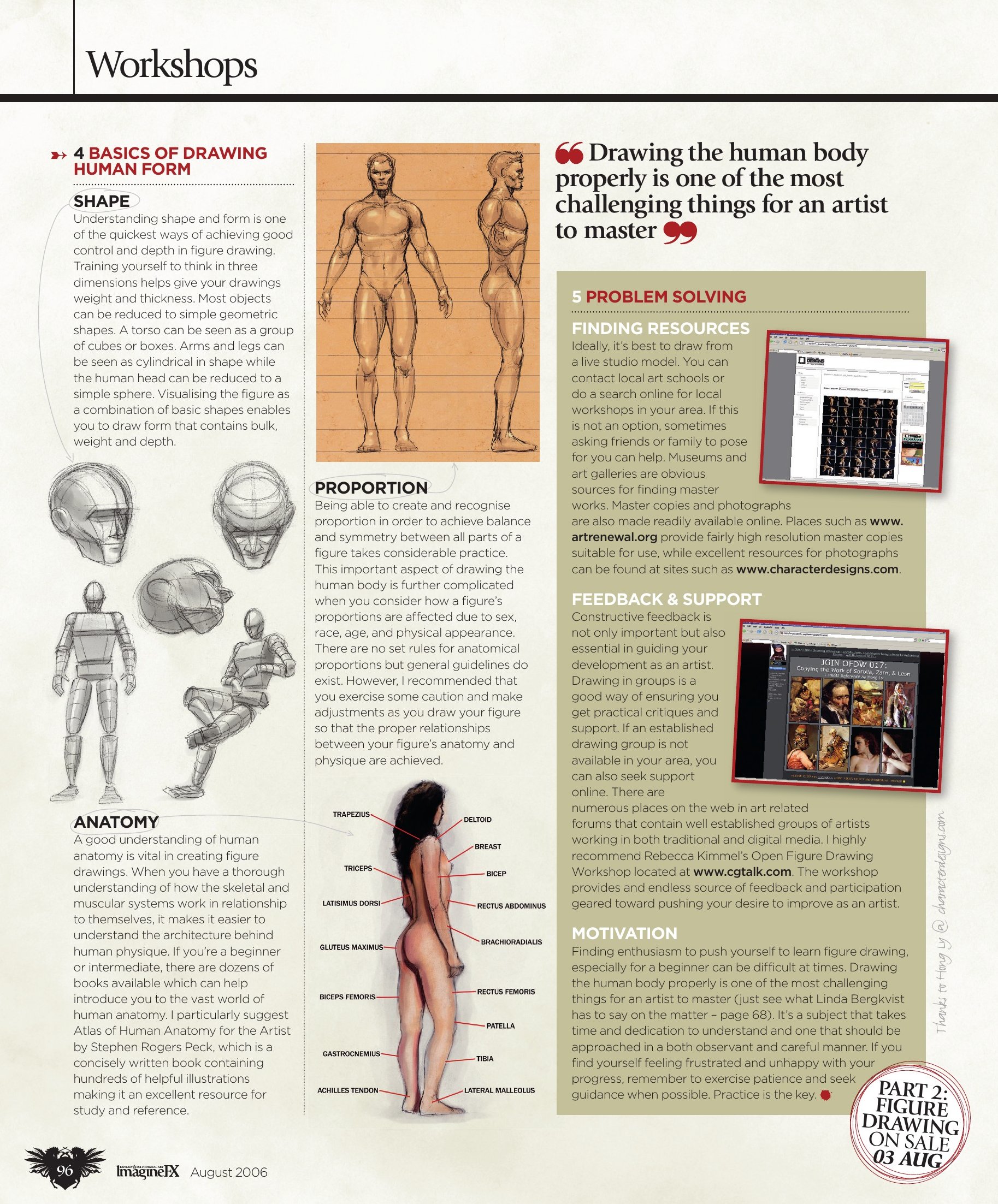
Anatomy - A good understanding of human anatomy is vital to create good figure drawings. When you have a thorough understanding of how the skeletal and muscular systems work in relationship to themselves, it makes it easier to understand the architecture behind human physique all the greater. If you are a beginner or intermediate, there are dozens of books available which can help introduce you to the world of human anatomy. I particularly suggest Atlas of Human Anatomy for the Artist by Stephen Rogers Peck, which is a concisely written book containing hundreds of illustrations making it an excellent resource for study and reference.
Proportion - Being able to create and recognize proportion in order to achieve balance and symmetry between all parts of a figure takes considerable practice. This important aspect of drawing the human body is further complicated when you consider how a figure's proportions are affected due to sex, race, age, and physical appearance. There are no set rules for anatomical proportions but general guidelines do exist. However, it is recommended that you exercise caution and make adjustments as you draw your figure so that the proper relationships between your figure's anatomy and physique are achieved.
Problem Solving
Finding Resources - Idealistically, it would be best to draw from a live studio model. You can contact local art schools or do a search online for local workshops in your area. If this is not an option, sometimes asking friends or family to pose for you can help. Museums and art galleries are obvious sources for finding master works. Master copies and photographs are also made readily available online. Places such as artrenewal.org provide fairly high resolution master copies suitable for use, while excellent resources for photographs can be found at sites such as characterdesigns.com.
Feedback & Support - Constructive feedback is not only important but essential in guiding your development as an artist. Drawing in groups is a good way of affording you practical critique and support. If an established drawing group is not available in your area, you can also seek support online. There are numerous places on the web in art related forums that contain well established groups of artists working in both traditional and digital media. I highly recommend Rebecca Kimmel's Open Figure Drawing Workshop located at cgtalk.com. The workshop provides an endless source of feedback and participation geared toward pushing your desire to improve as an artist.
Motivation - Finding enthusiasm to push you to learn figure drawing, especially for a beginner can at times be difficult. Drawing the human body properly is one of the most challenging things for an artist to master. It is a subject that takes time and dedication to understand and one that should be approached in both an observant and careful manner. If you find yourself feeling frustrated and unhappy with your progress, remember to exercise patience and seek guidance when possible. Practice, practice and more practice is the key.